

Protecting Our Parish From Mosquito-Borne Threats
STPMAD works year-round to reduce the mosquito populations that threaten health, comfort and local commerce in St. Tammany Parish. We focus on science, safety, and service — applying the best mosquito management practices available while responding rapidly to public requests for assistance.
Early Voting – Friday June 12 thru Saturday, June 20 (Closed June 19)
Early Voting Hours – Weekdays – 8:30am – 6:00pm; Saturday – 8:30am – 6:00pm; Sunday – closed
Locations:
Covington:
601 N. Jefferson Avenue
St. Tammany Justice Center Parking Garage
across from the Justice Center in Downtown Covington
Slidell:
520 Old Spanish Trail – The Towers Building
first floor conference training area
Mandeville:
21490 Koop Drive – Council Chambers
First building on the left
What Makes St. Tammany Parish Mosquito Problems Unique:
- 846 sq. miles of land area
- Diverse habitat: coastal marshes and bayous, suburban areas and rural woodlands
- Clay soils impacting drainage and water retention
- More septic systems than any other parish in LA: 36,000
- Consistently warmer temps mean rapid mosquito development
What We Do:
- Monitor mosquito activity throughout the parish using data-driven surveillance systems.
- Treat mosquito larvae and adults using Integrated Mosquito Management protocols, backed by science and environmental safeguards.
- Educate residents about mosquito biology, control methods, and disease prevention.
1,000,000 acres treated
by plane and helicopter
700,000 acres
treated by truck
over 800,000 mosquitoes
trapped each year
280,000 mosquitoes
tested each year
273,263 residents
served each year
What to Know About the Millage
- 1 source of revenue for service—100% of funding
- $9.3 million
- Renewed by vote every 10 years
- Last Renewal was in 2016 at 4.2 mils
- Renewal Election is coming up June 27 at 2.95 mils
- This is a reduction of 1.25 mils
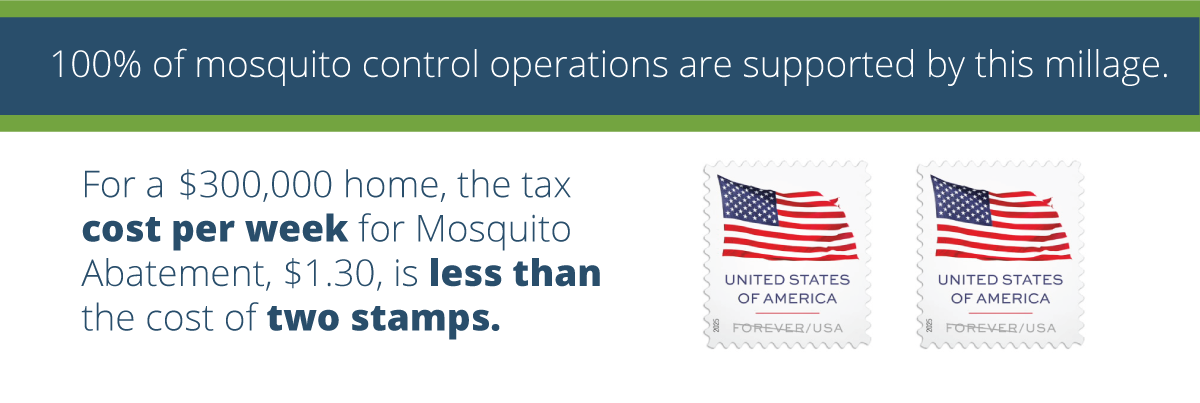
- 2.95 mils is $65 for a home valued at $300K
- A dedicated millage ensures reliable funding for these essential services, protecting families, businesses and visitors across the parish.
How STPMAD Works
- Integrated Mosquito Management: STPMAD’s operations are grounded in science and guided by data. We conduct regular surveillance and adapt treatments based on actual conditions on the ground.
- Core Components:
- Surveillance & Trapping: Mosquito traps are checked regularly to guide treatment decisions.
- Larvicide Treatments: Target mosquito larvae before they become biting adults.
- Adult Control: Nighttime applications by truck, jeep, plane or helicopter when mosquito activity is highest.
- Evaluation & Research: Monitoring population trends and treatment effectiveness.
- Public Education: Materials and outreach help residents reduce mosquito habitat around their homes and yards.
Transparency & Accountability/How Your Tax Dollars Are Used
- STPMAD is funded by a dedicated millage included on property tax bills. We continuously update our budget and operational plans to deliver the best mosquito management possible.
- That funding supports:
- Surveillance systems and lab partnerships
- Field treatments across the parish
- Public education and outreach programs
- Personnel and equipment for year-round operations
Get Involved
- Request a Service or Report a Problem: If you see a mosquito problem in your area, STPMAD staff is ready to help. We respond promptly to citizen service requests throughout the parish.
- Request to Receive Notification: you can register to receive a phone call, text, or email when we are treating your area.
- Schedule a Facility Tour: We welcome community members, reporters and civic groups to tour our facility and learn more about how mosquito management works. These tours give firsthand insight into the science behind our operations.
- Educational Presentations--STPMAD staff are available to speak to:
- Homeowners associations
- Business groups
- School and community organizations
- Civic clubs and local events
- Presentations can cover mosquito biology, disease risks, control strategies and how residents can reduce breeding habitat around their properties.
Frequently Asked Questions
Does STPMAD perform spray treatments on a set schedule?
No. Treatments decisions are made in direct response to data collected on mosquito development. Each week, we set traps, take landing rates and perform larval inspections to monitor mosquito populations. Treatments occur only when mosquito numbers or disease risk reach thresholds for treatment.
Are the spray treatments safe for humans and pets?
Yes. The products we use are approved by the EPA and undergo rigorous testing to ensure that they are safe for people and pets. Our treatments are applied at extremely low concentrations specifically designed to target mosquitoes and we strictly follow label guidelines. We use non-residual treatments, so that nothing remains on surfaces in the morning. Our applications are only applied at night when the beneficial insects are away for the night.
When I see a truck or plane performing a spray treatment, does that mean virus was found near me?
Not always. Treatments may occur when:
- When mosquito populations are excessively high, or
- When the laboratory has detected mosquito-borne viruses such as West Nile virus, Eastern equine encephalitis, or St. Louis encephalitis.
Each year, we reevaluate our Integrated Mosquito Management Plan which includes thresholds for spray treatments. Each data point has its own threshold: landing rates, number of mosquitoes that are capable of spreading disease, number of nuisance mosquitoes, virus test results, resident complaints and other important considerations.
What is STPMAD spraying into the ditch water?
The primary treatment we use is called Bti, or Bacillus thuringiensis israelensis, a natural, soil-borne bacteria, it is safe for organic farming and only impacts mosquitoes, black flies, and midges.
Sometimes I see the guy driving the Jeeps skip over ditches with their spray treatment. Shouldn't they spray every single ditch.
Good question – they are only treating when conditions are appropriate and when the water sources actually contain mosquito larvae. If no larvae are present or environmental conditions are unsuitable, they skip over the ditch. Our biologists are continuously inspecting these ditches for mosquito activity.
What is STPMAD's current surplus?
In accordance with recommendations from the Louisiana Legislative Auditor, our agency maintains a financial reserve equal to roughly one-third of a year’s operating budget. The LLA recommends that public agencies keep some funds available in reserve to ensure uninterrupted services in the event of a hurricane or other emergencies.
Why do mosquitoes bite my wife more than me?
Mosquito females are attracted to a number of elements: carbon dioxide, skin bacteria, body heat, and in there is evidence to show that they are even attracted to certain blood types. Some people produce stronger attractants, making them more appealing to mosquitoes.
Does the spray treatment kill honeybees or fireflies?
Our spray treatments are designed to target active, flying mosquitoes at night when bees and other beneficial insects are not active. Our treatment applications occur after sunset to reduce exposure to pollinators like honeybees. Fireflies can be active at the time of treatment, so there is a chance that they could be impacted by the treatments. We calibrate the droplet size to 30-40 microns to specifically target the mosquitoes body size. To give you an idea of how small that is the average width of a single strand of hair is 70 microns – so these are very small droplets, which is less impactful on a larger insect like a firefly. Some residents remark on how they are seeing less fireflies in St. Tammany, but that is primarily attributed to loss of habitat from development and light pollution – which disrupts their mating signals.
What steps can I take to reduce mosquitoes on my property?
The best step you can take is to reduce habitat:
- Once a week empty all containers holding water.
- Maintain pools and fountains
- Clean gutters and drains
- If you have water that cannot be drained, consider releasing mosquitofish into the water. We raise the native minnow fish at our office and will give them to residents for free to establish a natural ecosystem in permanent aquatic habitat.
And remember to protect yourself! Wear repellent, avoid peak biting times, and wear long sleeves and pants to make less skin available!
Given how fast mosquitoes reproduce, how can we ever win the battle?
Mosquito control is about management, not elimination. Through continuous surveillance, source reduction, and targeted treatments, we keep mosquito populations below levels that threaten public health or quality of life.